StormDebris:
The History of Meteorology
The Hygrometer and the Measurement of Humidity
Date: 15th–18th centuries (early forms to standardized instruments)
Location: Europe (Italy, Switzerland, France, England)
Type: Scientific instrument
Author: Leonardo da Vinci; Francesco Folli; Horace-Bénédict de Saussure
Why it matters: Enabled the measurement of atmospheric moisture, contributing to the rise of quantitative meteorology
Timeline placement: The Instrumental Turn
The hygrometer is the instrument used to measure humidity, or the amount of water vapor present in the air. While moisture has always been a central component of weather, it remained largely intangible for most of human history, experienced through sensation rather than quantified observation.
Early attempts to measure humidity emerged in the Renaissance and early modern period, when natural philosophers began seeking ways to make invisible atmospheric properties observable. Devices ranged from organic materials that changed shape with moisture to increasingly refined mechanical and chemical systems.
By the eighteenth century, hygrometers had become recognizable scientific instruments. They played a key role in the broader shift toward quantitative meteorology, where atmospheric phenomena were no longer described only qualitatively but measured, compared, and recorded over time.
The hygrometer did not simply measure dampness. It helped transform humidity from a subjective experience into a variable that could be studied, standardized, and incorporated into scientific understanding of the atmosphere.
Historical Context

Before the development of hygrometers, humidity was perceived rather than measured. Dampness could be felt on the skin, seen in condensation, or inferred from weather conditions, but it lacked a numerical framework. This placed it in a similar position to temperature and pressure prior to the invention of thermometers and barometers.
One of the earliest known attempts to measure humidity is attributed to Leonardo da Vinci, who designed a device in which a material such as wool would expand or contract depending on moisture in the air. Though rudimentary, the idea was conceptually significant: it treated humidity as a measurable physical property rather than a purely qualitative condition.
In the seventeenth century, instrument makers began developing more systematic approaches. Francesco Folli constructed hygrometers using organic materials that visibly responded to changes in moisture. These early devices were sensitive but inconsistent, as natural materials varied in their responses.
The eighteenth century brought important refinements. According to Horace-Bénédict de Saussure, reliable measurement required careful selection and calibration of materials. Saussure developed a hair hygrometer using human hair that expanded and contracted predictably with humidity. His work emphasized reproducibility and precision, key features of emerging scientific instrumentation.
As meteorology became increasingly instrument-based, hygrometers joined thermometers and barometers as part of a growing observational network. Together, these tools allowed atmospheric conditions to be recorded systematically rather than described impressionistically.
An 18th-century brass hygrometer (MHS 449) preserved at the Musée d’histoire des sciences in Geneva, Switzerland. The instrument represents early attempts to quantify atmospheric humidity using mechanical response systems, translating moisture in the air into measurable physical movement.
Early hygrometers relied on the physical response of materials to moisture. Organic substances such as hair, wool, or plant fibers absorb water from the air. As they do, their length or tension changes. This change can be translated into motion, typically through a lever or pointer, allowing humidity to be indicated on a scale.
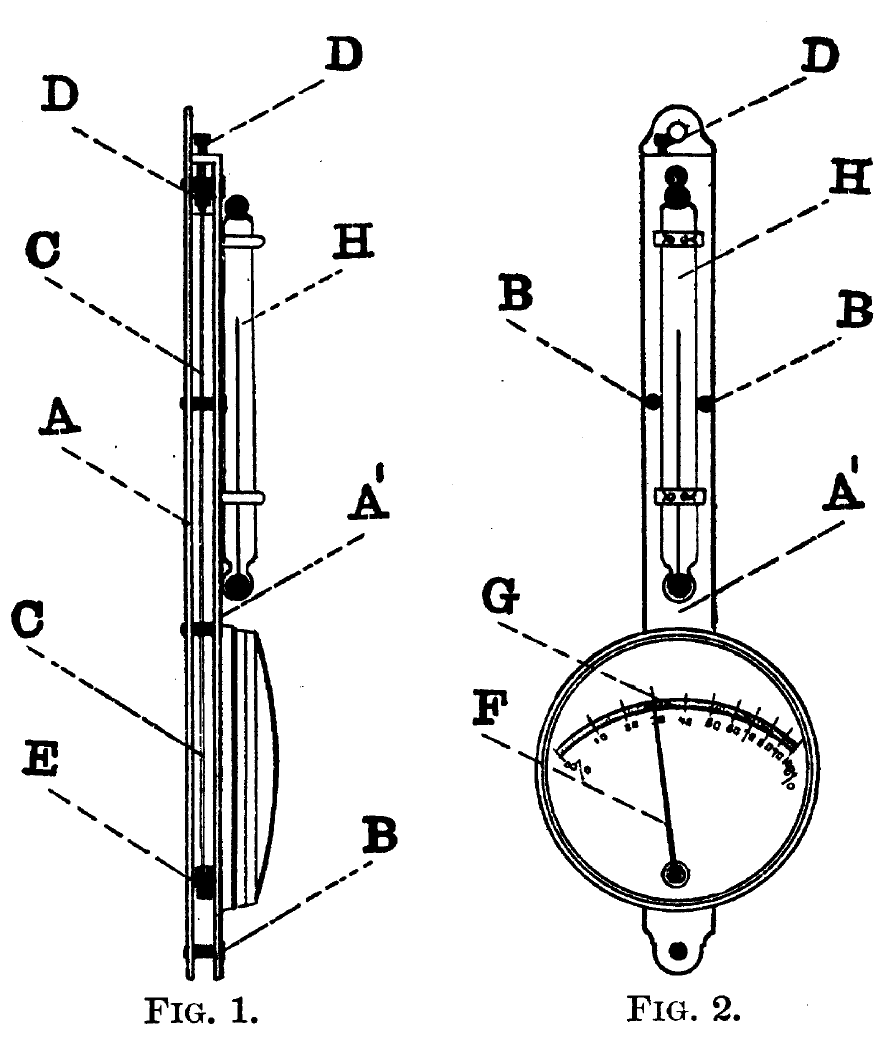
The hair hygrometer developed by Horace-Bénédict de Saussure is one of the best-known examples. In this device, a bundle of human hair is kept under tension. As humidity increases, the hair absorbs moisture and lengthens; as the air dries, it contracts. These small changes are mechanically amplified and displayed on a calibrated dial.
Later designs introduced chemical and physical principles beyond organic expansion. Condensation hygrometers, for example, determine humidity by identifying the temperature at which water vapor condenses (the dew point). Psychrometers use paired thermometers, one dry and one wrapped in a wet cloth, to infer humidity from temperature differences caused by evaporation.
In all cases, the goal is the same: to convert an invisible property of the air into a measurable quantity. Humidity is typically expressed as relative humidity, a percentage indicating how much water vapor is present compared to the maximum the air can hold at a given temperature.
What It Proposed

A precision hygrometer (MHS 1036) housed in the Musée d’histoire des sciences in Geneva, Switzerland. This instrument is part of a broader collection of eighteenth- and nineteenth-century meteorological devices used to study atmospheric moisture. Its finely engineered construction reflects the transition from simple moisture-sensitive materials to calibrated scientific instruments capable of quantifying relative humidity.
Strengths and Insights
The hygrometer represents a crucial step in making atmospheric moisture measurable. Its primary contribution lies in transforming humidity from a subjective sensation into a quantifiable variable that can be compared across time and location.
As historians of science such as Liba Taub have noted, early meteorological instruments did more than produce data. They reshaped how atmospheric phenomena were understood, encouraging observers to think in terms of variables, relationships, and patterns rather than isolated experiences.
The hygrometer also revealed the variability of humidity. Moisture levels fluctuate throughout the day, across seasons, and between environments. By making these fluctuations visible, the instrument contributed to a more dynamic understanding of the atmosphere.
In combination with thermometers and barometers, hygrometers enabled more comprehensive observation. Weather could now be described through multiple interacting measurements, laying groundwork for later developments in forecasting and atmospheric science.
Limitations and Errors
Despite its importance, early hygrometers faced significant challenges. Devices based on organic materials were sensitive but inconsistent. Hair, for example, varies depending on its source, treatment, and environmental history. This made calibration difficult and limited comparability between instruments.
There was also no universal humidity scale in early development. Different instruments used different reference points, and standardization emerged only gradually. As a result, early measurements were often relative rather than absolute, useful for local observation but less reliable for broader comparison.
Even more refined designs required careful maintenance and environmental control. Condensation hygrometers depended on accurate temperature measurement, while psychrometers required consistent airflow and precise readings. Small errors in setup could produce significant differences in results.
These limitations reflect a broader pattern in the history of scientific instruments. Measurement does not simply reveal nature; it depends on materials, calibration, and agreed standards. The hygrometer’s development illustrates how difficult it is to stabilize a measurement for something as variable and intangible as atmospheric moisture.
Historical Impact
The hygrometer became an integral part of the instrumental toolkit that transformed meteorology in the seventeenth and eighteenth centuries. Alongside the thermometer and barometer, it contributed to a shift from qualitative description to quantitative observation.
In the eighteenth and nineteenth centuries, networks of observers began recording humidity alongside temperature and pressure. These records allowed patterns to be identified and compared across regions, contributing to the emergence of climatology as a field of study.
The instrument also found applications beyond meteorology. Hygrometers were used in fields such as agriculture, manufacturing, and preservation, where moisture levels affect materials and processes. Their practical value reinforced the importance of accurate measurement.
Over time, hygrometers evolved into more precise and reliable devices, incorporating electrical and digital sensing technologies. Yet the underlying principle remains consistent: the translation of atmospheric moisture into measurable data.
The measurement of humidity did not emerge fully formed. It developed through experimentation, refinement, and standardization. The hygrometer stands as part of the broader transformation in which the atmosphere became something that could be systematically measured, recorded, and understood.
Related Pages
Timeline
This development belongs to the period when atmospheric phenomena became measurable through instruments.
Themes
The hygrometer contributes to the quantification of atmospheric variables.
Later Developments
Advances in humidity measurement continued alongside broader technological change.
Sources & Notes
Primary Sources
Middleton, W. E. Knowles. A History of the Thermometer and Its Use in Meteorology. Johns Hopkins University Press, 1966. https://archive.org/details/thermometer0000unse/page/n6/mode/1up
Secondary Sources
Fleming, James Rodger. Meteorology in America, 1800–1870. Johns Hopkins University Press, 1990. Accessed via the Internet Archive.
Taub, Liba. Ancient Meteorology. Routledge, 2003. Preview accessed via PagePlace.
Notes
-
Early hygrometers varied widely in design; terminology such as “hair hygrometer” refers to a class of instruments rather than a single standardized model.
-
Relative humidity as a standardized measure emerged gradually alongside advances in thermodynamics and atmospheric science.
Revision Note
Last reviewed: April 2026