StormDebris:
The History of Meteorology
The Instrumental Turn
17th-18th Centuries
The instrumental turn marks a fundamental shift in how weather was understood. During this period, atmospheric phenomena began to be measured rather than inferred, recorded rather than described, and compared rather than remembered. Instruments made it possible to quantify temperature, pressure, wind, and precipitation, transforming weather from a qualitative experience into numerical data.
This transition did not occur all at once. Early instruments were uneven in design and reliability, and their adoption reshaped both observation and theory. Nevertheless, the instrumental turn represents the moment when meteorology began to move toward systematic, empirical practice.
What This Period Encompasses
The instrumental turn refers to the growing reliance on mechanical and physical devices to observe the atmosphere. Measurement altered not only what could be known, but how knowledge was evaluated.
During this period:
• Weather observations became increasingly numerical
• Instruments introduced the need for calibration and standardization
• Observations could be compared across time and location
• Subjective judgment gave way, gradually, to recorded data
Rather than replacing earlier ideas immediately, instruments coexisted with older explanatory frameworks, reshaping them over time.
Time Period Covered
This section broadly spans:
• The late medieval and early modern period
• The introduction of early thermometers, barometers, and rain gauges
• The gradual spread of instrumental observation through the 17th and 18th centuries
While precise dates vary by region and instrument, this era represents the transition from qualitative observation to quantitative measurement, preceding the rise of coordinated observation networks.
What You’ll Find in This Section
• The origins of early meteorological instruments
• How measurement changed the language of weather description
• Early challenges in accuracy, consistency, and interpretation
• The cultural and scientific implications of quantifying the atmosphere
Entries in this section focus on how instruments altered meteorological practice, rather than on technical specifications alone.
c. 1593–1724

The Thermoscope to Thermometer: Measuring Heat and Cold
Traces the transition from the early thermoscope to the standardized thermometer, showing how heat and cold became measurable quantities. The development of temperature measurement helped transform meteorology from qualitative observation into a quantitative science.
c. 1643–1667

The Anemometer and the Quantification of Wind
A foundational development in the quantification of atmospheric motion. Emerging in the early modern period, the anemometer provided one of the first reliable methods for measuring wind speed, transforming wind from a qualitative experience into a measurable variable within scientific observation.
1686

Edmond Halley and the Mapping of Global Winds
This work represents a key moment in early modern science, when observation from maritime exploration began to merge with theoretical explanation. Although later models would refine and correct his mechanisms, Halley’s approach helped establish the idea of a dynamic, planet-wide atmosphere shaped by systematic physical processes rather than isolated regional effects.
Timeline Archive
1611

Strena Seu de Nive Sexangula and the Geometry of Snowflakes
One of the earliest works to explore the geometry of snowflakes through mathematical reasoning. Written in 1611, Johannes Kepler’s Strena Seu de Nive Sexangula examined why snow crystals display sixfold symmetry and helped lay conceptual foundations for crystallography and the study of natural patterns.
1643

Torricelli’s Barometer and the Discovery of Atmospheric Pressure
One of the first experimental demonstrations that air has weight and exerts measurable force on the physical world. Developed in 1643, Evangelista Torricelli’s barometer experiment replaced long-standing qualitative explanations of suction and vacuum with a quantitative model of atmospheric pressure. It shows how changes in weather and altitude can be understood through variations in the weight of the air column above the Earth, marking a foundational step in the development of modern meteorology and atmospheric physics.
18th century

Dew Point, Condensation, and Early Hygrometric Tables
A foundational exploration of how moisture in the air becomes measurable through condensation, linking dew formation to early attempts at quantifying atmospheric humidity. Developed across the eighteenth and nineteenth centuries, it traces the emergence of dew point as a physical threshold and the rise of hygrometry as a numerical approach to understanding weather and atmospheric change.
c. 1639–1662

The Rain Gauge and the Measurement of Precipitation
One of the earliest instruments used to systematically measure precipitation. Developed in standardized form during the 15th century, the rain gauge transformed rainfall from a matter of observation into quantifiable data, laying part of the foundation for instrumental meteorology and long-term weather recordkeeping.
1660s–1780s
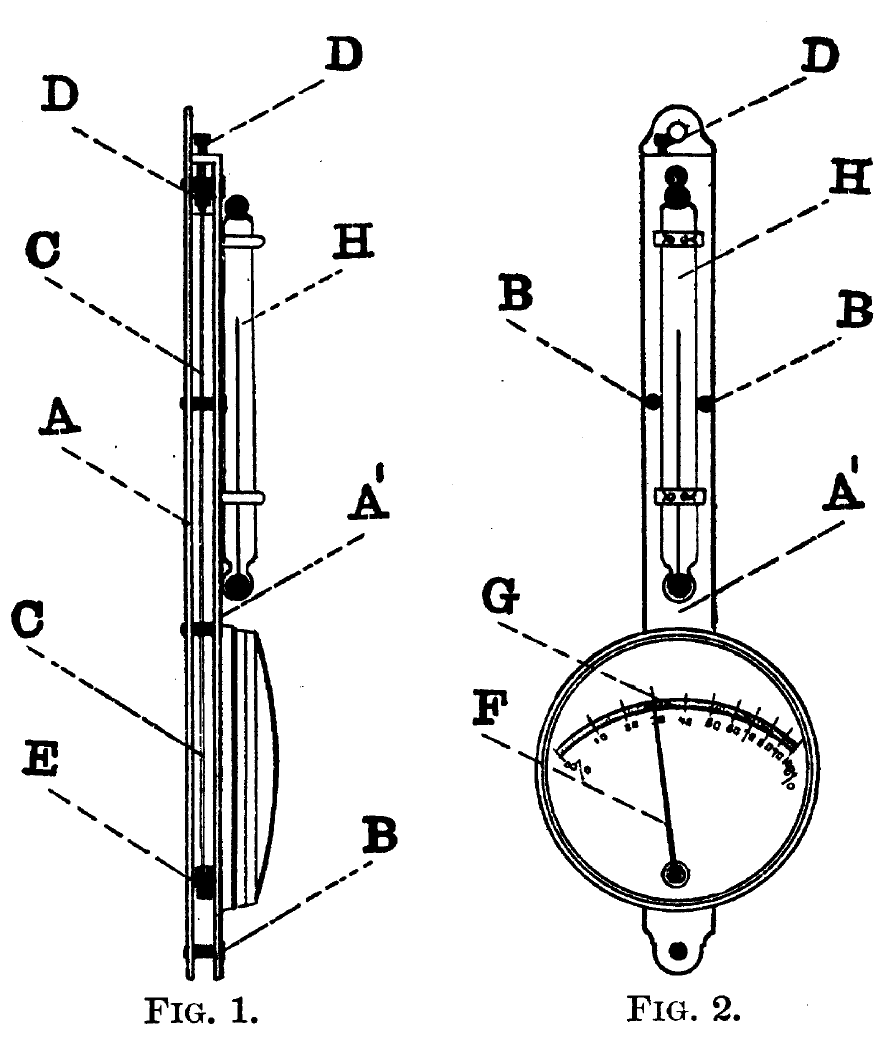
The Hygrometer and the Measurement of Humidity
One of the earliest attempts to make atmospheric moisture measurable rather than merely perceptible. Developed across the Renaissance and early modern period, the hygrometer transformed humidity from a subjective experience of dampness into a quantifiable property of the air. It provides a window into the gradual shift toward instrument-based meteorology, where invisible atmospheric conditions could be observed, compared, and recorded.
c. 1700–1742

Standardization and the Problem of Measurement Scales
The problem of standardization and measurement scales marks a turning point in the history of science, when atmospheric observation shifted from local, instrument-bound readings to shared and comparable numerical systems. Emerging between the 17th and 19th centuries, it reveals how temperature and pressure measurements were gradually aligned through common reference points, enabling scientists to translate scattered observations into a unified language of data.
How This Period Connects to the Archive
The instrumental turn links early conceptual explanations to later developments in meteorology. It:
• Builds on ideas introduced in Antiquity & Early Weather Knowledge
• Enables advances explored in Forecasting & Theory
• Lays the groundwork for Institutions & Networks by making standardized observation possible
Without instruments, large-scale comparison and coordinated forecasting could not emerge.
A Note on Sources and Interpretation
Early instruments varied widely in construction and use, and their readings were often difficult to compare. Entries in this section draw on original descriptions, surviving instruments, and historical analysis to place measurements within their proper context.
Where data quality or interpretation is uncertain, those limitations are discussed as part of the historical process rather than treated as errors.