StormDebris:
The History of Meteorology
The Rain Gauge and the Measurement of Precipitation

Date: c. 15th century CE (standardized instrument in Korea; earlier antecedents elsewhere)
Location: East Asia (Korea), with parallel developments in South Asia and later Europe
Type: Measurement instrument
Author: Sejong the Great; Jang Yeong-sil
Why it matters: First systematic quantification of rainfall
Timeline placement: The Instrumental Turn
The rain gauge marks a turning point in the study of weather: the moment when rainfall ceased to be merely observed and began to be measured. Emerging in different forms across Asia, the Middle East, and Europe, the instrument transformed precipitation from a qualitative experience into a quantifiable phenomenon.
One of the earliest standardized rain gauges was developed in 15th-century Korea during the reign of Sejong the Great. Known as the cheugugi, it allowed officials to systematically record rainfall for agricultural and administrative purposes. Similar efforts appeared elsewhere, including early designs described in India and later refinements in Europe during the scientific revolution.
The introduction of the rain gauge did something quietly radical. It gave rain a number. Instead of “heavy” or “light,” rainfall could now be recorded, compared, and analyzed over time. This shift laid the groundwork for modern meteorology, where precipitation is tracked across regions and centuries, feeding into everything from flood prediction to climate science.
Historical Context

Before the invention of rain gauges, rainfall existed as a shared human sensation rather than a standardized quantity. Farmers, sailors, and officials relied on descriptive language and accumulated experience. Rain might be “abundant,” “scarce,” or “timely,” but such descriptions resisted comparison across regions or years.
The need for measurement was driven in part by administration. In agrarian societies, rainfall determined crop yields, taxation, and famine risk. According to historians of Korean science, the court of Sejong the Great sought more reliable data to manage agriculture across the kingdom. This led to the development of the cheugugi in 1441, a standardized rain gauge distributed to regional offices.
As described in studies of East Asian science, including those by Joseph Needham, the Korean system was notable not just for the instrument itself but for its bureaucratic integration. Officials were required to measure rainfall using identical devices and report their findings to the central government. Measurement became policy.
Parallel ideas appeared elsewhere. Texts from India, such as the Arthashastra attributed to Kautilya, describe methods for estimating rainfall using containers, though these were less standardized. In Europe, systematic measurement would emerge later, particularly in the 17th century, when natural philosophers began designing instruments to quantify atmospheric phenomena.
The rain gauge thus arose at the intersection of practical necessity and emerging scientific curiosity. It reflects a broader shift from qualitative observation to quantitative record-keeping, a transition that would eventually define modern science.
A set of rain gauges at the Jang Yeong-sil Science Garden in Busan, South Korea. These reconstructed instruments represent early Joseon efforts to standardize rainfall measurement for agricultural and administrative use.
At its core, the rain gauge is deceptively simple: a container designed to collect precipitation, paired with a method for measuring the accumulated water. Yet within this simplicity lies a conceptual breakthrough.
The cheugugi consisted of a cylindrical vessel of standardized dimensions. Rainfall was measured by the depth of water collected in the cylinder, typically expressed in units tied to the local measurement system. Because the diameter of the container was fixed, the depth directly represented the amount of rainfall over a given area.
This principle remains unchanged in modern gauges. Rainfall is expressed as a depth, usually in millimeters or inches, representing the height of water that would accumulate on a flat, impermeable surface. A rainfall of 10 mm, for example, means that 10 millimeters of water would cover the ground if none were absorbed or drained away.
Later designs in Europe refined the instrument. According to accounts from early modern scientists such as Christopher Wren and Robert Hooke, rain gauges were adapted to improve accuracy and consistency. Some included funnels to reduce evaporation and measurement errors, while others incorporated calibrated measuring tubes.
Despite variations in design, the underlying idea remained constant: rainfall could be captured, measured, and recorded as a numerical value. The sky’s generosity became a column of water, quiet and exact.
What It Proposed
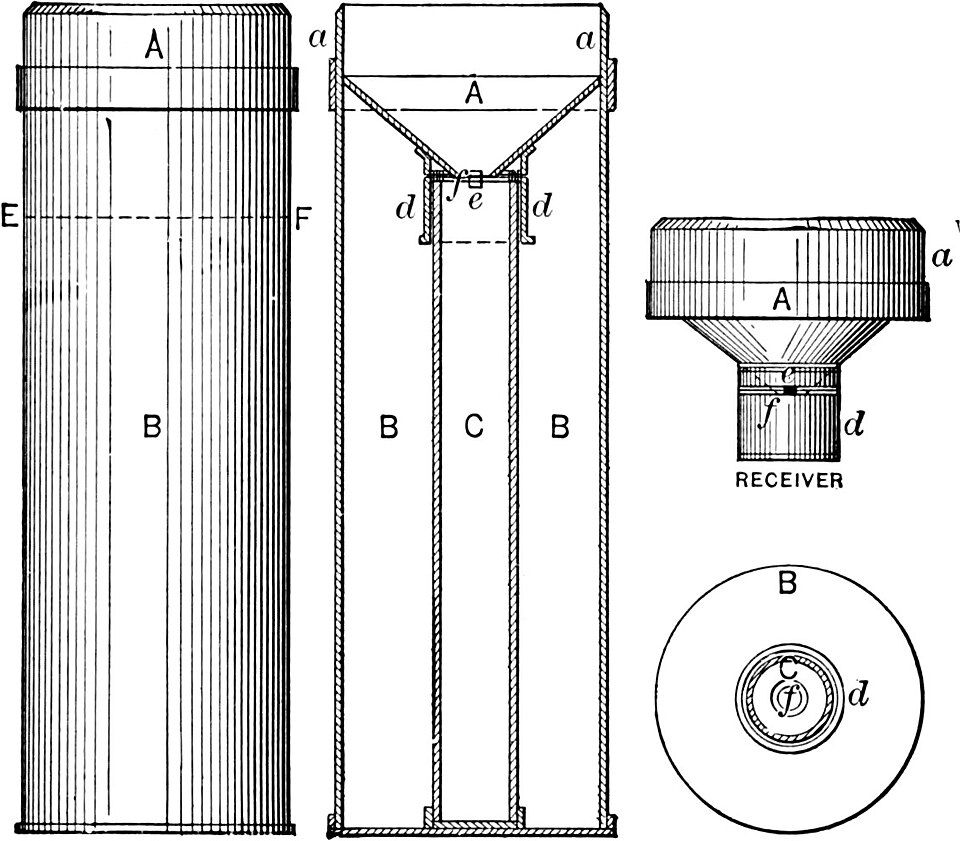
Rainfall is measured in terms of depth rather than volume, with rain gauges translating collected water into a standardized numerical record. The illustration from Jacques W. Redway’s Handbook of Meteorology (1921) shows how precipitation was analyzed in early instrumental meteorology, where water collected in a gauge is converted into inches or millimeters of rainfall based on a fixed measuring scale.
Strengths and Insights
The rain gauge’s greatest strength lies in its clarity. It translates a complex atmospheric process into a single, comparable number. This transformation enabled several key advances.
First, it allowed for standardization. By using identical instruments, observers in different locations could produce comparable data. According to Joseph Needham’s analysis of East Asian science, the Korean rain gauge system represents one of the earliest examples of coordinated meteorological measurement.
Second, it enabled accumulation of long-term records. Rainfall data could be tracked over seasons and years, revealing patterns that would otherwise remain invisible. Variability, drought cycles, and regional differences could be documented rather than inferred.
Third, it supported practical decision-making. Governments could use rainfall data to assess agricultural conditions, predict shortages, and adjust policies. Measurement turned weather into information, and information into action.
Finally, the rain gauge helped shift the epistemology of weather itself. It reinforced the idea that atmospheric phenomena could be studied quantitatively, paving the way for later instruments such as thermometers and barometers. In this sense, it belongs to the early architecture of scientific measurement, where observation begins to crystallize into data.
Limitations and Errors
Despite its conceptual elegance, the rain gauge is not without limitations. Measurement depends heavily on placement, design, and environmental conditions.
Wind, for instance, can deflect raindrops, causing undercollection. Evaporation can reduce the recorded amount, particularly in simpler designs. Splashing, debris, and uneven placement can introduce further inaccuracies. Even today, standardized guidelines are required to ensure reliable measurements.
Early rain gauges faced additional challenges. Without precise manufacturing techniques, maintaining consistent dimensions across instruments was difficult. Units of measurement varied between regions, complicating comparison. As a result, early datasets, while valuable, are not always directly compatible with modern records.
Moreover, the rain gauge measures only one aspect of precipitation: accumulation. It does not capture intensity, drop size distribution, or the dynamics of rainfall events. These require more advanced instruments and observational methods.
As with many early scientific tools, the rain gauge’s limitations reflect the conditions of its use. It provided a new kind of knowledge, but that knowledge was shaped by practical constraints and evolving standards.
Historical Impact
The rain gauge occupies a pivotal place in the history of meteorology. It represents one of the earliest successful efforts to measure an atmospheric variable systematically and at scale.
In Korea, the cheugugi system established a precedent for state-sponsored scientific observation. Measurement became part of governance, linking environmental data to administrative decision-making. This integration of science and policy foreshadows modern meteorological agencies.
In Europe, the adoption of rain gauges in the 17th century contributed to the broader “instrumental turn” in science. As natural philosophers like Robert Hooke emphasized measurement, weather began to be studied through data rather than description alone. Rainfall records became part of emerging scientific networks, where observations were shared and compared.
Over time, rain gauges became standard tools in meteorology. They form the backbone of precipitation records used in hydrology, agriculture, and climate science. Modern networks, from local weather stations to global monitoring systems, still rely on the same basic principle first embodied in early instruments.
The arc from the cheugugi to modern automated gauges is long but continuous. The device itself is simple, a container open to the sky. Its significance lies in translating rainfall into measurable data.
Related Pages
Timeline
This work belongs to the intrumental phase of meteorology.
Themes
The Rain Gauge contributes to the conceptual foundations of atmospheric theory.
Later Developments
Later transformations in meteorology emerged in response to the creation of measurement instruments.
Sources & Notes
Primary Sources
Kautilya. Arthashastra. Translated by R. Shamasastry. https://archive.org/details/arthashastra0000kaut/page/7/mode/1up
Secondary Sources
Needham, Joseph. Science and Civilisation in China, Volume 3: Mathematics and the Sciences of the Heavens and the Earth. Cambridge University Press. Accessed via the Internet Archive.
Strangeways, Ian. Measuring the Natural Environment. Cambridge University Press. Accessed via the Internet Archive.
World Meteorological Organization. Guide to Meteorological Instruments and Methods of Observation. Accessed via the WMO Library.
Notes
-
The Korean cheugugi (1441) is widely regarded as the first standardized rain gauge system, though earlier forms of rainfall collection are described in Indian texts such as the Arthashastra.
-
Measurement units and reporting practices varied across regions; standardization developed gradually over time.
Revision Note
Last reviewed: April 2026